Rank choice voting is also called "instant run off voting."
Rank choice voting undoes the political polarization of the two party duopoly that paralyzes the democratic process in most of the United States.
Rank choice voting is also called "instant run off voting."
Rank choice voting undoes the political polarization of the two party duopoly that paralyzes the democratic process in most of the United States.
Steve McIntosh’s book, Developmental Politics, is a book about political philosophy based on a meta narrative about cultural evolution. McIntosh’s philosophy is based on the importance of values, what matters to people, and how people view the world through the lens that they have been socialized and conditioned to use for their perspective.
Most politics in the United States is based on scarcity and fear rather than abundance and love. This dichotomy contributes to the polarization of American society which is fueled by a desire for power and dominance. Rather than cooperating, collaborating, and working together toward common goals, the strategy is to demonize people who disagree and to subjugate, oppress, and disenfranchise them from participation in democratic processes. This has led increasingly to a resurgence of violence and domestic terrorism in addition to verbal, mental, and emotional abuse.
McIntosh writes that the resolution to this problem of political polarization is what he calls “values integration” and the facilitation of spiritual growth. The difficulty with the application of these strategies of values integration and spiritual growth is the lack of institutional support.
The current social institutions most likely to facilitate values integration and spiritual growth might be academia and religion but both of these social institutions have been co-opted by political parties and “think tanks.”
New organizations and institutions need to be created, nurtured, sustained, and well managed in order for values integration and spiritual growth to become a prominent part of American society.
Each of us can start wherever we find ourselves to find other like minded people to join together to work toward goals of developing emotional and spiritual intelligence.

The work of building a better society ultimately involves improving the “civic virtue” of individual persons, and this cannot be accomplished by cultural evolution alone. To effectively cultivate character development and thereby foster the authentic betterment of our people, the project of evolving culture ultimately requires spiritual growth.
McIntosh, Steve. Developmental Politics: How America Can Grow Into a Better Version of Itself (p. 128). Paragon House. Kindle Edition.
The level of spiritual intelligence in the people of the U.S. is very low. They are not aware of their stages of points of view and that these points of view can be described from an evolutionary map: traditional, modern, postmodern.
Understanding that the primary values of people at the different stages transform as a person grows up is missing from our national consciousness. McIntosh makes the point that this map of evolutionary development begins with the individual and then becomes the norms and attitudes of groups and then becomes the culture of a society.
The facilitation of positive development begins with the raising of consciousness initiated by people whose level of consciousness is already at a more developed stage. This is done primarily by demonstration and example not by words. People at higher levels of spiritual intelligence have a salubrious effect on those they interact with. Actions speak louder than words.
Steve Gaskin said one time that in the end all that we have to offer another human being is our own state of being.
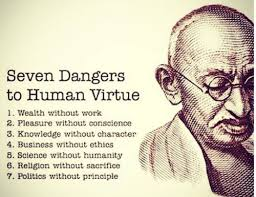
Virtues are traits of moral excellence or strengths of character whose practice can lead to both ethical living and satisfying happiness. Although the concepts of virtues and values are interrelated, there is an important distinction. As we’ve seen, values are magnetic, they provide the aims and goals that attract us toward that which is more perfect, more real, and more right. Values represent the improved future conditions we desire. Virtues, on the other hand, represent the good qualities we presently possess; the acquired attributes of excellence that become engrained into our basic nature through commitment and practice. Values are the best of what we want, but virtues are the best of who we are. Simply put, values are headings and virtues are habits—“habits of the heart,” as they’ve been called.
McIntosh, Steve. Developmental Politics: How America Can Grow Into a Better Version of Itself (pp. 130-131). Paragon House. Kindle Edition.
The idea of virtue rarely is discussed in public any more. When we consider which candidates to vote for virtue is rarely a consideration. Certainly Donald Trump was no paragon of virtue nor some would argue was Hillary Clinton.
It would seem that politics is a dog eat dog kind of enterprise and virtue, good character, is not considered a necessary or even a desirable qualification.
How important is virtue and character when you choose a political candidate to vote for?
In Integral philosophy there are the concepts of "evolution" and "involution." Simply put, evolution is the process from the bottom up where something smaller becomes something more complex while involution is the process from the top down where something greater is reduced to its component parts.
McIntosh uses the word "development" now instead of "evolution."
This need to ground the good, the true, and the beautiful in the political life of our nation brings us back to the distinct value sets described in Part I as “heritage values,” “liberty values,” “fairness values,” and “caring values.”
As originally mapped out in figures 4.5 and 4.6 on pages 54-55, each of these value sets can be understood as discrete bandwidths of value energy, or as distinct “octaves” in the ascending scale of our human aspirations for goodness, truth, and beauty. These four discrete sets of political values derive their magnetic power from the underlying intrinsic values which they help concretize and translate into accessible cultural identities. By rendering these intrinsic values into political agendas that are relevant to real-world problems and opportunities, each of these cultural categories defines its own version of the American Dream.
McIntosh, Steve. Developmental Politics: How America Can Grow Into a Better Version of Itself (p. 115). Paragon House. Kindle Edition.
This map of value sets or stages of consciousness lends itself to determining where we are at as groups within our nation and the nation as a whole and where we might want to go.
We have seen the struggle over heritage values with the taking down of confederate flags and statues. We have seen the oscillation in liberty values in joining the Paris Climate Agreement and then withdrawing from it, from supporting NATO to the threat of leaving NATO. We have seen the debate over fairness values with Affirmative Action policies and the debate over CRT. We have seen the struggle over caring values with the debate over Global alliances, immigration, and universal income.
In these debates we have become, some say, more polarized and divided and if you observe social policy making in the red and blue states there are distinct differences in the policies the electorate supports. There is a question now about our mutual preference for the use of democratic processes with the Big Lie Republicans wanting a more authoritarian and less democratic form of government.
Which value octave do you sing in: Heritage, liberty, fairness, or caring? Maybe a little from all four which is the Integral position hoping that there can be some sort of harmony if we can coordinate how we sing together.
As I’m arguing, in order to overcome hyperpolarization, we need people to expand their own values so they can better recognize the validity of their opponents’ values. This kind of growth in values, however, requires the raising of people’s consciousness. While raising consciousness is the long-term goal of developmental politics, as activists from across the political spectrum have discovered, raising consciousness takes time and can be exceedingly difficult. But by employing the method of values integration, we can begin to craft the new political positions that would be possible if values had already been expanded and the consciousness of the electorate had already been raised. In short, we don’t have to wait for people to raise their consciousness, we can do it for them! Because the integral perspective deeply appreciates the values of each worldview, it already includes the valid concerns of each category in its positions without requiring potential opponents to argue for their side. The method of values integration thus allows us to approach political issues with the best interests of each value category already in mind. In fact, by adopting an integral perspective we might even be able to revere and defend the values of each category better than that category’s own partisans.
McIntosh, Steve. Developmental Politics: How America Can Grow Into a Better Version of Itself (p. 68). Paragon House. Kindle Edition.
McIntosh writes that the political dynamics could be improved with values integration.
Values integration is the recognition and acknowledgement of the primary values at each stage of consciousness or worldview. What is the good, the true, and the beautiful to people at the pre-traditional, traditional, modern, postmodern, and post postmodern stages? Polling shows that Americans pretty much value the same things, but disagree on how to implement those qualities in society. The conflicts are not so much over the what but the how.
Take abortion for example. Most people are pro life but whose life are we talking about, an unborn embryo or the life of the mother and her family? The conflict hinges on agreement of when life begins. Roe vs. Wade determined that life begins at extra uterine viability at 24 weeks, but the Christian Nationalists argue that life begins at conception and some even argue that it begins at ejaculation. How are these conflicts to be resolved in a society which utilizes a democratic process to make policy? In the case of abortion, the policy is determined by a court of 9 justices who are out of step with the majority of Americans who value the woman’s right to self determination more than the continued development of an embryo.
The discussion could perhaps be better conducted if the subject of the debate was shifted from when life begins to the concept of freedom as self determination of living persons. Freedom and self determination is a value about which most Americans agree.
Is this what they mean by "American exceptionalism?" pic.twitter.com/QW1tk2EXVt
— Robert Reich (@RBReich) July 6, 2022


